Tilt after losses
Your win rate falls while your size climbs after a losing streak. The broker shows neither.
NextScalp Journal
Self-hosted trading journal for crypto futures. Rebuild Binance or Bybit fills into real trades and see where you lose.
NextScalp Journal is a self-hosted trading journal for crypto futures. Give it a read-only Binance or Bybit key and it pulls your USDT-margined futures fills, income and funding, rebuilds them into real round-trip trades and shows where you actually lose: revenge trades after a losing streak, profit given back before the exit, how often you break your own rules. It runs on your own server, VPS or machine - Docker bundles the app and Postgres - and your trades never pass through a NextScalp backend, because there is none. It costs $59 once: the full source code and 12 months of updates, with nothing that renews on its own. Free open-source journals are a fine place to log trades. NextScalp Journal is built for the step after logging: behavior, exit and discipline analysis that turns a trade history into a short list of specific leaks to fix.
Your broker gives you a flat list of fills. It never tells you that your win rate collapses after two losses, that one coin carries your whole month, or that you keep trading past the line you swore you'd stop at.
Your win rate falls while your size climbs after a losing streak. The broker shows neither.
One ticker, one trade. Drop it and the edge is gone, but the equity curve hides it.
You were green and let it run flat. The fills don't measure the profit you handed back.
Past your daily stop, over your size cap, in your no-trade hours. Nothing flags it.
The radar watches the market. The mirror shows how you trade.
NextScalp Bot and NextScalp Journal are two independent tools under one standard. This page is the mirror.
One pipeline, end to end, all of it on your own server. Your secrets never reach a browser.
Read-only Binance or Bybit futures fills, income and funding.
Scale-ins and partial exits collapse into one real trade per cycle.
Each trade tagged with volume, prior move and its MFE / MAE.
Stored in your own database. There is no vendor backend.
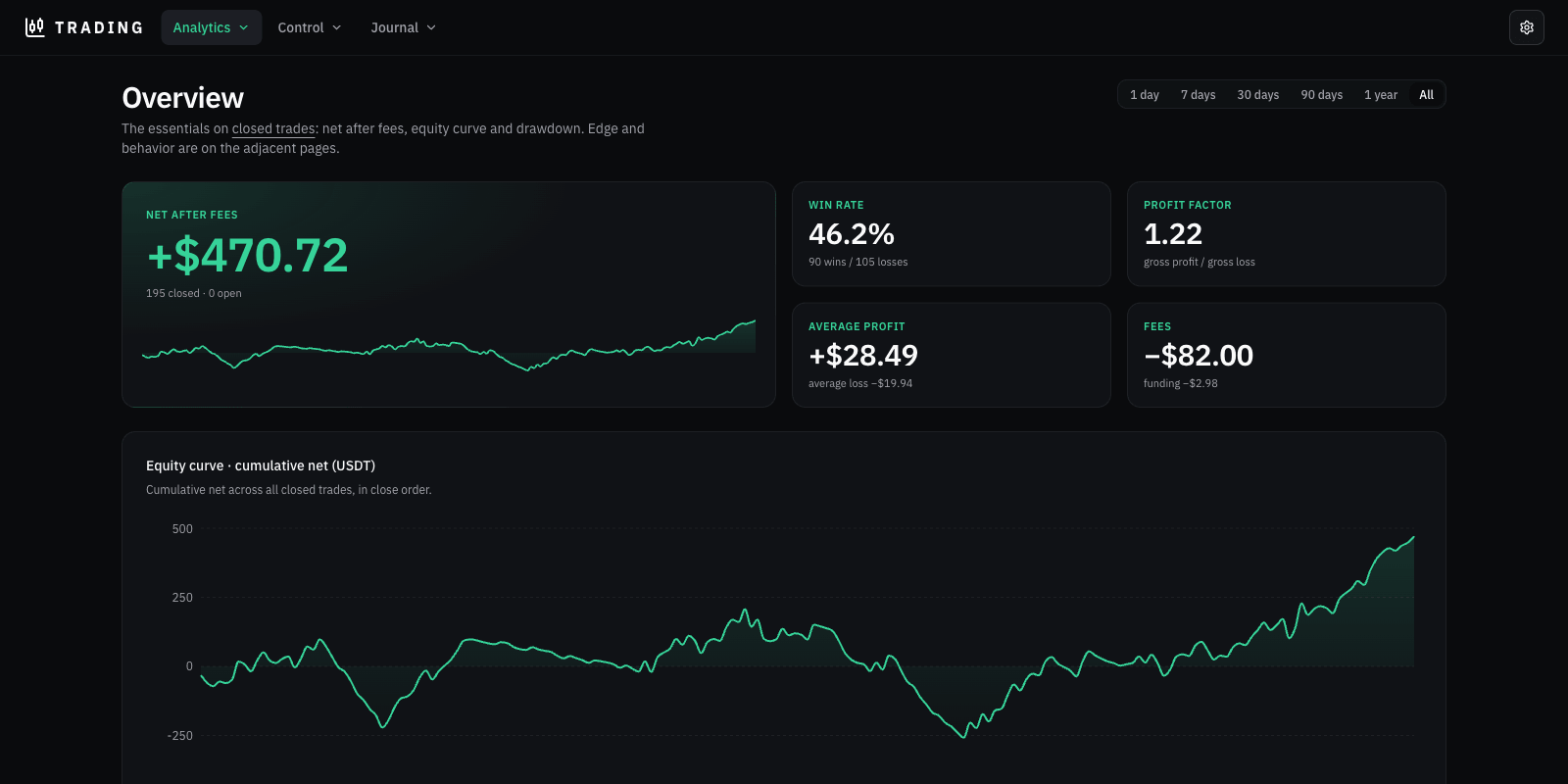
Server-rendered analytics, read straight from your data.
Your fills power the baseline. Your journal tags make the behavioral cuts sharper - missing intent is never guessed.
The behavioral read no flat ledger can give you, scored from your own trades and your own journal tags.
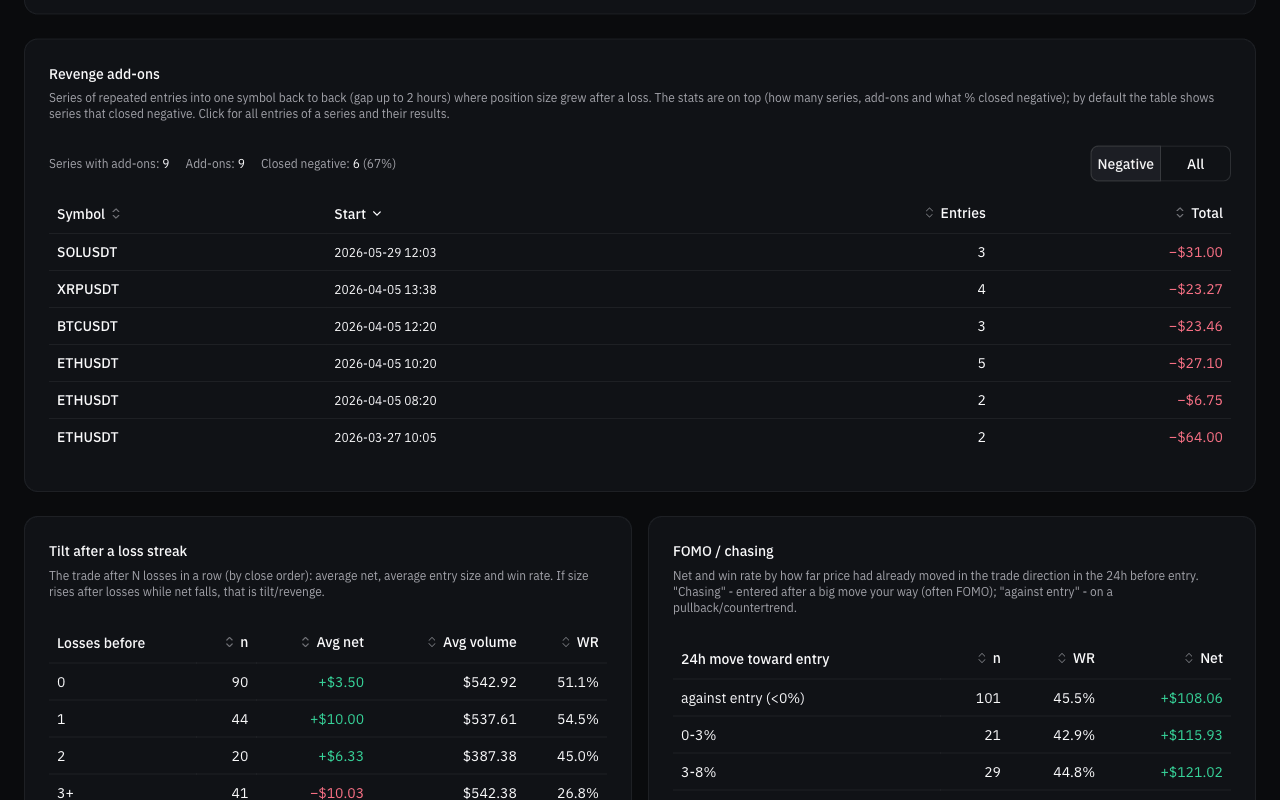
Back-to-back re-entries into the same symbol where size grew after a loss. The trade you take after a losing streak, with its average net, size and win rate. When size climbs while net falls, that is tilt, quantified.
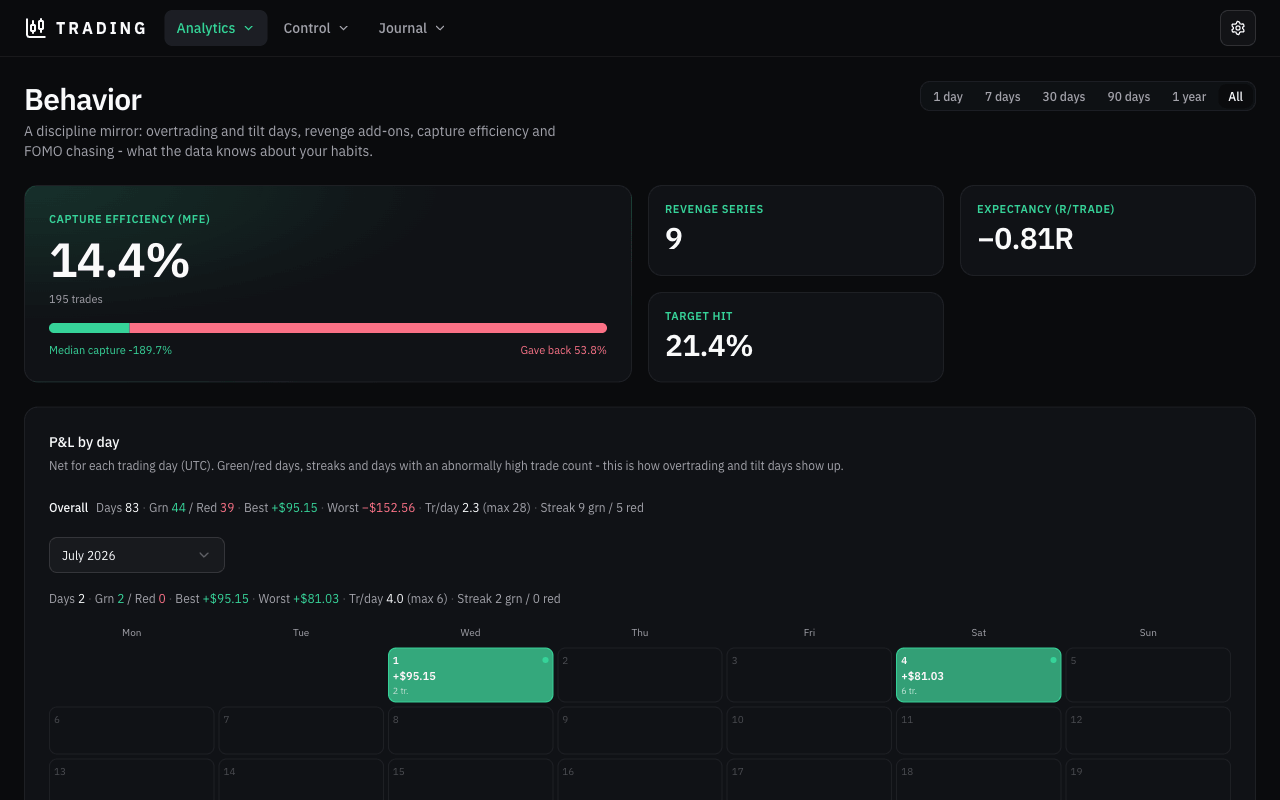
How much of the favorable move you actually took before you exited. Net and win rate by how far price had already run before your entry. Results in R against your planned stop, with the profit you left on the table.
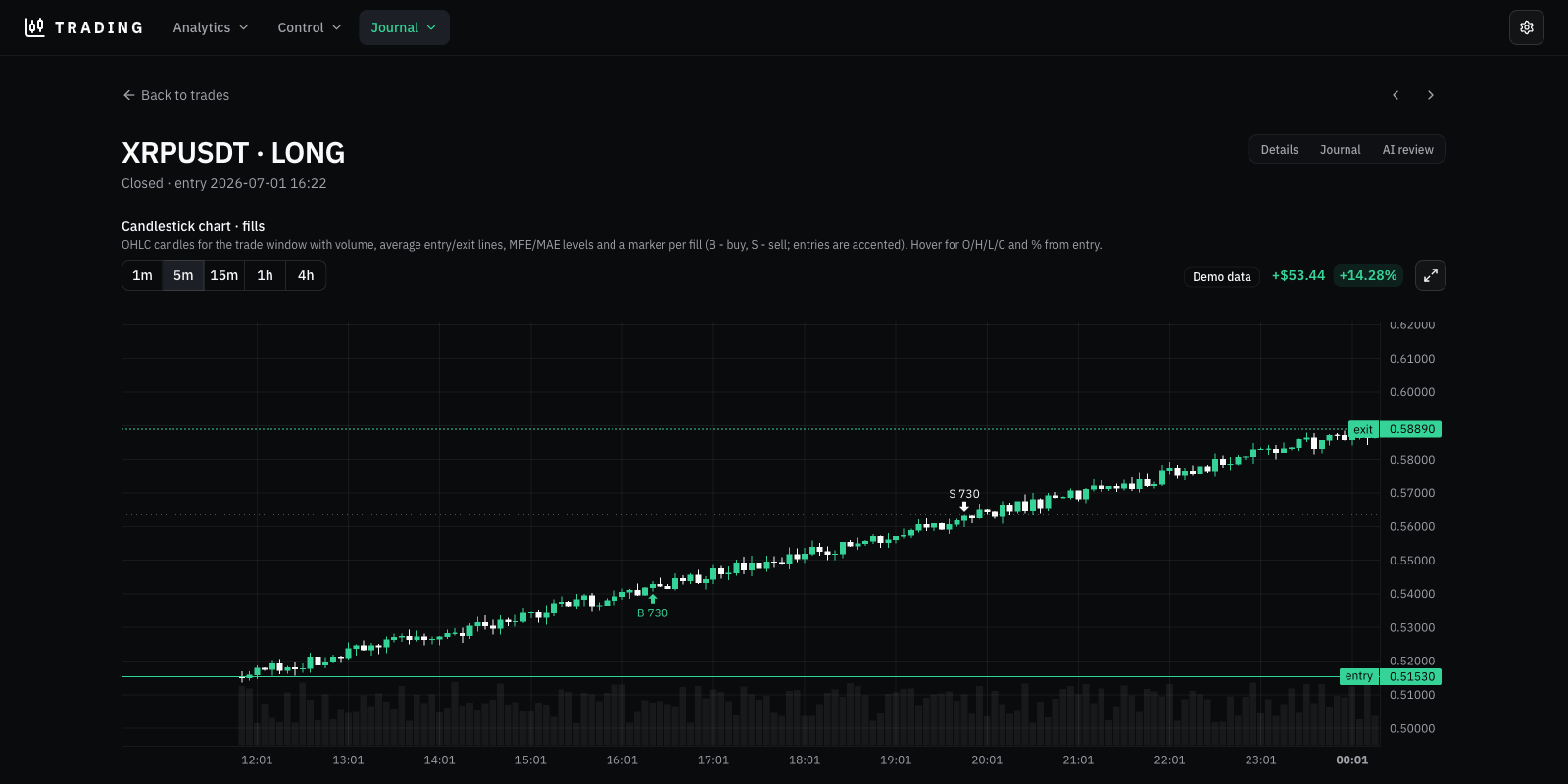
Price action, your fills, your intent and the outcome, side by side on every round-trip.
OHLC over the trade window with every fill marked, average entry and exit, MFE / MAE, and your planned stop and target when set.
Record why you entered, why you exited, the setup, the emotion, the planned stop and target, and the lesson. Those tags feed Edge and Behavior. One-tap suggestions from data you already own - trend vs counter-trend, exit-at-plan, a re-entry after a loss - help you fill them faster. Nothing is auto-applied.
Scale-ins and add-backs fold into one logical trade, counted once everywhere. The dashboard even spots the candidates, reversible with one split.
Every exit, replayed on your own trades, never on a model's imagination. See the profit you gave back at the exit, and which exit rule would have kept it.
The total you were up at each trade's peak and did not keep, shown next to your real capture. Then: if every trade had simply exited at the target and stop you wrote in the journal, what would the book have made? Your plan net, beside your actual net, so you see whether your discretion helped or hurt.
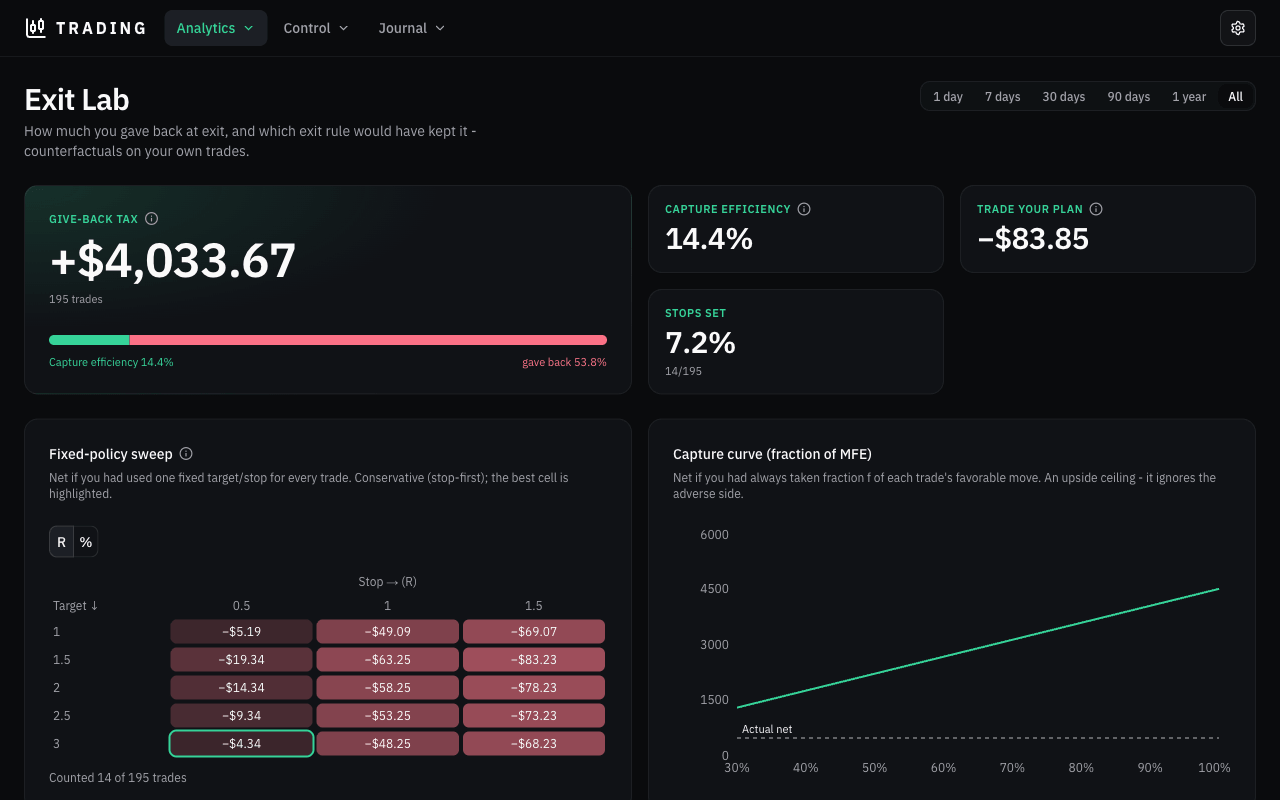
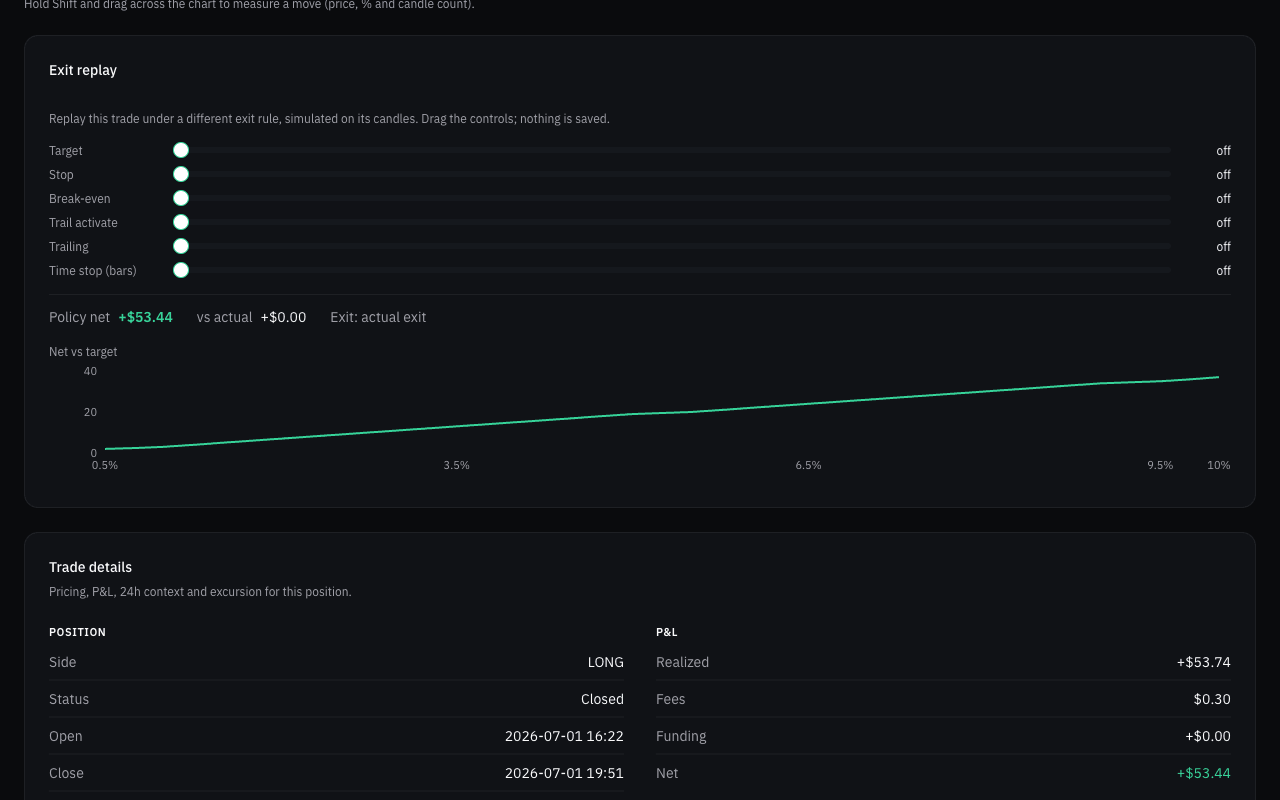
A grid scores every fixed target-and-stop over your trades and highlights the best, in R or in percent. On any single trade, drag the target, stop, trailing stop, break-even and time-stop and watch the outcome recompute live on its real candles. A sandbox: nothing is saved, nothing is placed.
Three groups share one time range, 7 days to all-time, that windows every metric on the page. Two more surfaces sit outside the look-back.
Analytics
Control
Journal
Before the trade
The coins you are watching, the levels that would make you act, and a Telegram ping when price gets there.
Between trades
Bar replay on real history: play a past session forward, blind, and rehearse the decision without hindsight.
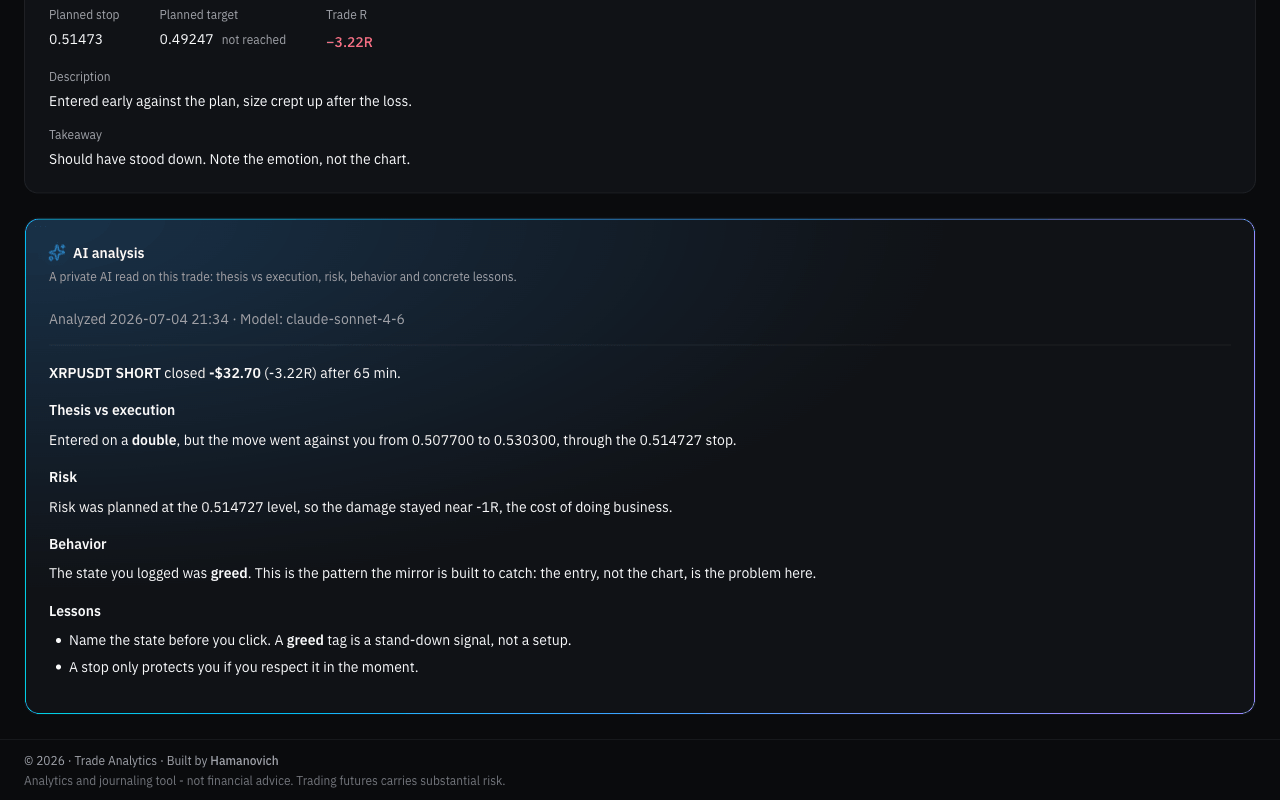
Opt-in, through your own Anthropic key: when you ask for an analysis, the trade data you selected goes straight from your box to Anthropic and never passes through NextScalp. Leave the key unset and it simply stays off.
One tap reads the trade's own numbers, your journal entry and your discipline rules, then explains thesis versus execution. It streams in, renders as markdown, and is saved per trade.
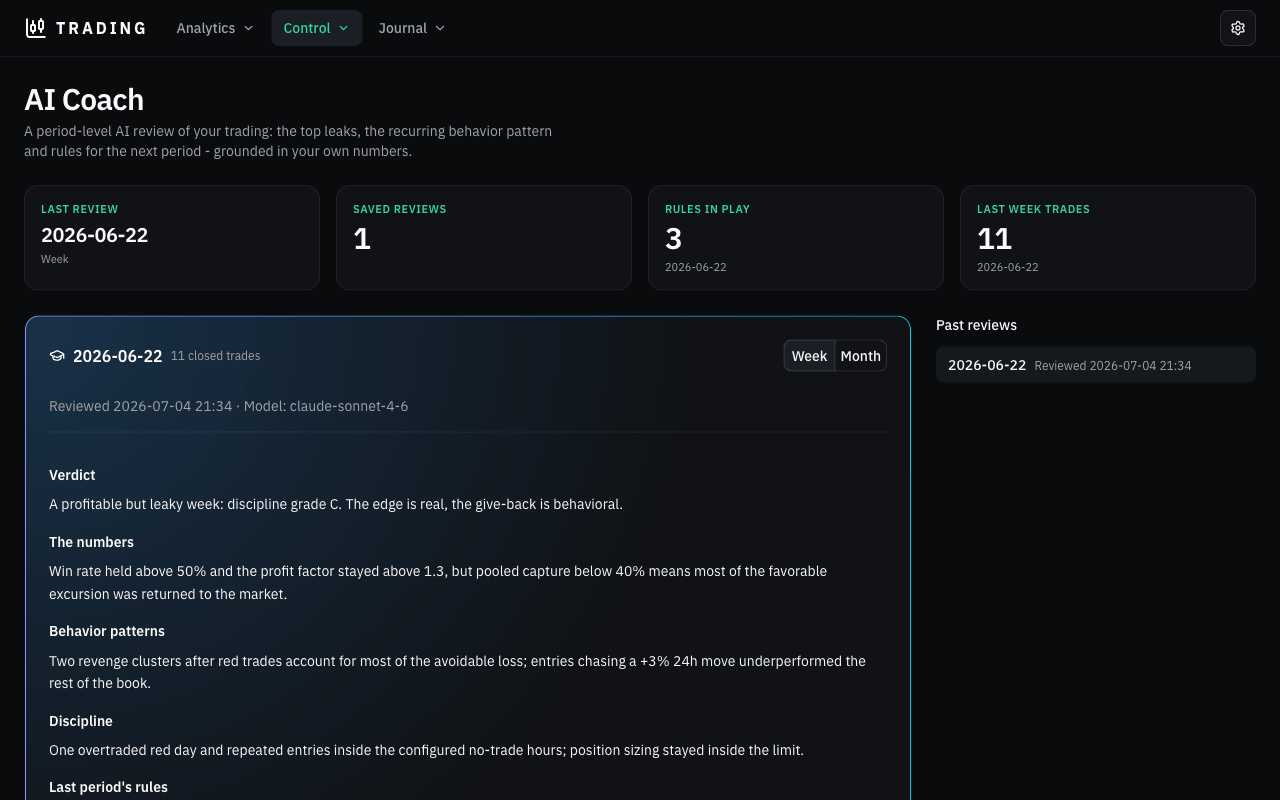
Lift the lens to the week or month: a review that names your recurring patterns, grades how well you kept last period's rules, and sets a short, concrete list for the next one, all grounded in that period's real numbers.
Not an account on someone else's cloud. You run the app, the database and the keys yourself - on a server, a VPS, or your own machine, for as long as you like.
Trades, P&L and journal notes live in your own Postgres. No vendor backend holding a copy.
The sync only needs read access. It can never place, modify or withdraw. Ever.
Keys and the database client never reach the browser. A bundle scan proves it on every build.
A Telegram-id allow-list gates every route. No separate identity provider to register, no auth tables.
App and Postgres bundled, migrations applied on start. One command and your env.
Built for USDT-margined perpetual futures: funding, 24h context, liquidity, 24/7 sessions.
Everything else here looks backwards. The Terminal looks forward: it holds the work you did on the chart before the trade, so your plan survives the hours between marking a level and price actually reaching it. It doesn't find setups. It remembers yours.
One card per coin you are watching, each with your own note on why it is interesting. The list you would otherwise keep in your head.
Direction is derived from price, never chosen: above is a breakout up, below is a breakout down. You see the live distance in percent as you type.
A watcher checks prices every few seconds and messages you once when the level is reached. Not a stream, not a re-notification.
24h volume, change, volatility, long/short ratio, distance to the day's high and low, open interest and the funding countdown, beside a chart with your level drawn on it.
Priority, colour flags and a lifetime of 2h, 4h or end of day, so yesterday's setups clear themselves out instead of piling up.
Every level on the panel is one you drew yourself. The Terminal is memory and timing for your own analysis - it never tells you what to trade.
Reviewing your history teaches you what went wrong. It cannot teach you to act while the candle is still forming - by then the outcome is known and every decision looks obvious. The trainer puts you back inside a real session, one bar at a time.
Pick a symbol and a time, or click a candle to start there. Play, pause, step one bar forward or back, run it from 1x to 10x.
Switch 1m, 5m, 15m and 1h mid-session. Deeper history is stitched in on the left; everything right of your cursor is never handed to the chart.
A random spot hides the symbol, the date, and even the price scale - the axis counts bars and the legend reads in percent. Hindsight has nothing to grab.
Random spots come from the instruments in your own history, and never from before a coin existed - you practise where you actually trade.
Shift and drag to measure any move, in percent while you are still blind. Reveal the answer when you are done.
No orders, no paper-trading ledger, no score to game. It is a practice ground, and it runs entirely on your own box.
Ships in English and Russian. Add your own in two guided steps, no code.
Set every discipline threshold, toggle each rule, and turn on strict mode.
A restrained emerald accent by default, an opt-in pure-monochrome Focus mode, dark and light themes.
Pick any timezone and every timestamp, the win-rate heatmap, the P&L calendar and daily streaks recompute in it.
A read-only instance loaded with a realistic few months of trades, every page populated. Walk the whole thing end to end before you ever point it at your account.
Open the live demoDemo data only. No account, no keys, nothing to sign.
$59 once
Secure checkout by Stripe. Already bought? Download here. Questions? journal@nextscalp.com
No. It is self-hosted. Your trades, P&L and notes live in your own database. There is no vendor backend to send them to. If you enable AI, the trade or period you selected goes directly from your server to Anthropic through your own API key - it never passes through NextScalp. Every outbound connection is listed on the security page.
Binance USDⓈ-M perpetual futures or Bybit linear perpetuals - one exchange per install, chosen at setup. It is built deep for that one instrument rather than shallow for many. Trade on both? Run two installs side by side (second folder, second port) under the same licence - one trader, as many of your own instances as you like.
No. Use a read-only API key. The sync only reads fills, income and funding. It can never place, modify or withdraw.
It is the easiest path: app and Postgres bundled, migrations on start. You can also point it at any external Postgres.
No. The whole dashboard runs without it. Set an Anthropic key and the per-trade audit and AI Coach turn on, through your own key.
Both. The per-trade audit reads a single position; the AI Coach reviews a whole week or month, grades how you kept last period's rules, and sets new ones. Both run only when you ask, through your own key, and stay in your database.
No. It analyzes trades you already took, and the Terminal watches only the levels you drew yourself - it never picks a coin or a direction for you. Finding the setup is the radar's job, that is NextScalp Bot.
No. They arrive through the same Telegram bot you already set up to log in, to the ids on your allow-list. One message per level, once.
Your licence key appears right after checkout, and it unlocks every release on the download page - source zip, stamped with your personal signed licence. Versions you receive inside your update window stay downloadable forever; no account, no password, just the key.
14 days, no questions asked - email us and the payment comes back. Try the live demo first; it is the full dashboard on realistic data.
Why a self-hosted journal, how a trade debrief actually works, and the risk rules the journal holds you to.
Inside NextScalp Journal - the self-hosted trading journal that rebuilds your Binance or Bybit futures fills into real trades and shows why you really lose.
Why the trade you should study is the one you just closed - how to judge the decision not the result, break the tilt loop, and run an honest debrief.
A complete guide to risk management for crypto scalpers - position sizing, leverage, stop placement, ATR, and why the math matters more than your win rate.
NextScalp Bot watches the Binance futures market in real time: it screens every USDⓈ-M perpetual, kills the noise through one strict quality gate, and sends only high-conviction setups to Telegram. NextScalp Journal watches your own process across the trades you take. Two independent tools, one standard - and the same no-custody DNA: no API keys, nothing traded for you.